A family hike or a weekend camping trip should be about making memories, not worrying about medical emergencies. But when you are exploring the outdoors with children and dogs, the risk of tick bites multiplies. Kids love to play in the exact environments where ticks thrive—tall grass, leaf litter, and brush—and dogs act as furry magnets for every tick in the forest.
Protecting your entire pack requires a proactive approach. Here is how to keep your children and pets safe from ticks this season.
Tick Safety for Kids
Children are particularly vulnerable to tick bites because of their height and their play habits. Ticks wait on the tips of grasses and shrubs (a behavior called “questing”) to grab onto passing hosts. For an adult, this usually means ticks attach at the ankle or knee. For a child, a questing tick is often at waist or chest height, giving the tick a shorter journey to the scalp or neck.
1. Dress for Defense When heading into wooded areas, dress your children in light-colored clothing. This makes it much easier to spot a dark tick crawling on them. Have them wear long pants and tuck the pant legs into their socks. It might look a little silly, but it forces ticks to climb up the outside of the clothing rather than accessing the skin.
2. Use Safe Repellents The CDC recommends using EPA-registered insect repellents containing DEET, picaridin, or oil of lemon eucalyptus. For children, DEET is considered safe and effective when used according to the label directions [1]. You can also treat their hiking clothes and shoes with permethrin, an insecticide that kills ticks on contact. (Note: Never apply permethrin directly to the skin.)
3. The Post-Hike Protocol As soon as you get home, put all hiking clothes directly into the dryer on high heat for 10 minutes to kill any hitchhiking ticks. Then, have your children shower. A shower will wash away unattached ticks and provides the perfect opportunity for a full-body tick check. Pay special attention to the scalp, behind the ears, in the belly button, behind the knees, and between the legs.
Tick Safety for Dogs
Dogs are highly susceptible to tick bites and tick-borne diseases, including Lyme disease, anaplasmosis, and ehrlichiosis. Furthermore, a dog can easily carry unattached ticks into your home, where they can later attach to you or your children.
1. Year-Round Preventatives Veterinarians strongly recommend keeping dogs on a year-round flea and tick preventative. These come in oral chews, topical liquids, or specialized collars. Because ticks can be active on any day the temperature rises above freezing, year-round protection is essential, especially in states with fluctuating winter weather [2].
2. Trail Tactics When hiking with your dog, try to keep them on the center of the trail. Avoid letting them plunge into dense underbrush or tall grass where ticks are concentrated. If you are going into heavy tick territory, you can use a dog-safe tick repellent spray as an extra layer of protection on top of their regular preventative.
3. The Grooming Check After a hike, thoroughly check your dog before they get back into the car or the house. Ticks love to hide in dark, warm places on a dog. Check inside and around the ears, under the collar, between the toes, under the front legs, and around the tail.
Be Ready to Remove
No prevention strategy is 100% effective. Eventually, you will find a tick attached to your child or your dog. When that happens, you need to remove it quickly and safely.
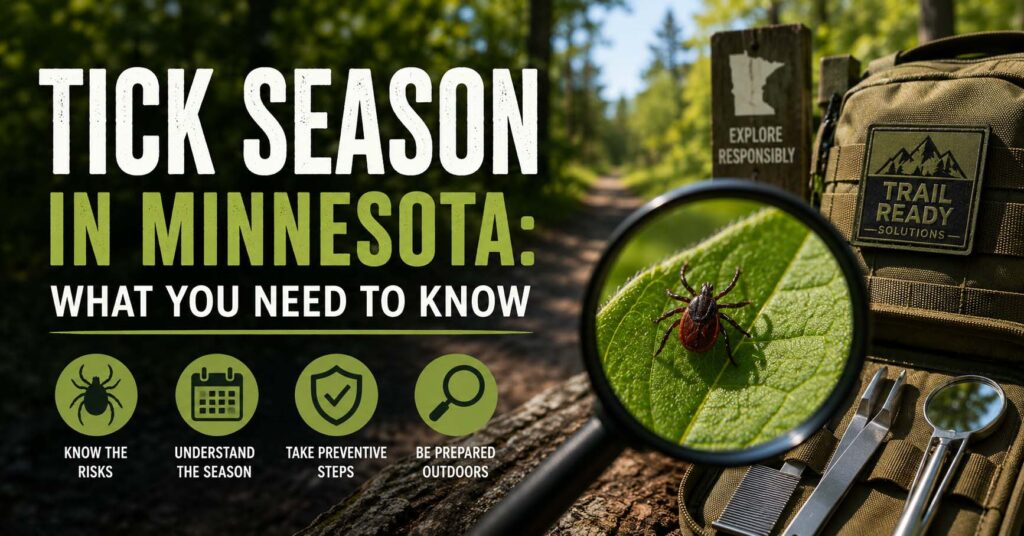
Do not try to pull a tick off your dog with your bare fingers, and do not use blunt household tweezers on your child. The Trail Ready Solutions Tick Removal Kit is the perfect family safety companion. It includes precision tools to safely extract the tick, a magnifying glass to ensure you got the whole head, and a stainless steel comb that is invaluable for checking both your child’s hair and your dog’s fur.
Keep a kit in your car or hiking backpack, and you will always be prepared to protect your pack.
References
[1] Connecticut Children’s, “Keeping Kids Safe from Ticks in Connecticut,” https://www.connecticutchildrens.org/growing-healthy/keeping-kids-safe-ticks-connecticut-step-step-guide-parents [2] PetMD, “The Complete Guide to Flea and Tick Prevention,” https://www.petmd.com/dog/general-health/flea-and-tick-prevention-and-treatment-dogs
© 2026 Trail Ready Solutions. All Rights Reserved.